Scaling Teams Without Scaling Overhead

Aidan Koh
CEO & Co-founder
8 min read
The playbook for growing from 50 to 300 people without proportionally growing coordination costs, management layers, or operational debt.
There is a specific inflection point that breaks nearly every fast-growing company, and it happens reliably between 50 and 150 people. The playbook that got you to 50 stops is working.
The communication structures, decision-making processes, and operational rituals that felt lightweight start to create drag so severe that teams begin to slow down even as headcount goes up.
The irony is brutal: the very growth you worked so hard to achieve starts working against you. Every new person adds coordination overhead. Every new team creates another interface to manage. Every new process adds friction to the ones it was supposed to help.
The overhead problem, quantified
Before fixing the problem, understand it precisely. Coordination overhead has three components:
COMMUNICATION OVERHEAD
62% - of a senior IC's time at 200-person companies spent on coordination vs individual contribution vs 38% at 50-person companies
DECISION LATENCY
4.8d - Average time for a routine cross-team decision at 200 people vs 1.2 days at 50, a 4× slowdown with no increase in decision quality
MEETING LOAD GROWTH
3.1× - Average meeting hours per person grow 3.1× from 50 to 200 employees, while output per person typically drops 30%
TARGET WITH AUTOMATION
≤30% - of senior IC time on coordination is achievable with the right operational design at any company size above 50
The four phases of organizational growth
Growth doesn't break teams all at once it breaks them at specific thresholds, each requiring a different response. Here are the four phases and what each demands operationally.
The Tribe Phase - 1 to 25 people
Everyone knows everything. Coordination is informal. Move fast.
At this stage, the CEO knows every open project, every customer, and every hire. Communication is ambient; people overhear decisions being made and self-coordinate. Documentation doesn't exist because it isn't needed. Don't try to build a process here.
The cost of premature structure at this phase in speed, culture, and hiring quality exceeds the cost of occasional chaos. The only thing worth investing in: a shared source of truth for customer data and product decisions.
The Village Phase — 25 to 75 people
First signs of coordination friction. Most critical phase for operational design.
This is where smart companies invest in operational infrastructure and where most companies don't. The patterns set here calcify good or bad.
Three investments that pay off most here:
A written decision log documents every significant decision with context and rationale
Sync-first communication norms define what requires a meeting vs a message
A single project management system that all teams actually use.
The last point is harder than it sounds. Partial adoption is worse than no adoption; it creates a two-tier system in which some work is visible, and some isn't. Related: our complete guide to async-first team operations.
The Town Phase — 75 to 200 people
Specialisation accelerates. Interface design between teams becomes critical.
At this phase, teams are large enough to have internal cultures, priorities, and vocabularies that diverge from each other. The #1 failure mode: cross-team interfaces are undefined.
Engineering and product disagree on what "ready for development" means; sales and CS disagree on who owns the onboarding handoff; finance and ops can't agree on what counts as a committed expense. Fix this explicitly.
Every cross-team interface should have a documented protocol: who owns the handoff, what the handoff state looks like, and how exceptions are escalated.
This is also the phase where automation investments yield the most return because repetitive cross-team workflows are now both high-volume and well-defined enough to build reliably.
The City Phase — 200+ people
Institutional knowledge becomes the bottleneck. Systems must carry what people used to.
At 200+, the people who were there at the beginning no longer have direct relationships with the majority of the team. Institutional knowledge, why decisions were made, what was tried and failed, what the product strategy actually is, lives in long-tenured employees' heads rather than in systems.
This is expensive: it creates decision-making bottlenecks, slows onboarding, and produces costly re-inventions of previously solved problems.
The solution is not more documentation; it's better-organized documentation attached to the workflows that need it. Every project, every recurring process, every recurring decision should have a linked knowledge artifact that's kept current.
AI-powered knowledge retrieval (part of Veltio's operations layer) makes this increasingly tractable.
The five mechanisms that actually prevent overhead accumulation
1. Standardise decision authorities, not decision processes
Most companies try to reduce coordination overhead by documenting decision processes who reviews what, in which order.
This adds friction rather than reducing it. The better approach: define authorities. This person can decide X up to $Y. This team can approve Z without escalation.
When authorities are clear, decisions don't need meetings; they need one person with a clear mandate. Amazon's "disagree and commit" culture is built on authority, not process.
2. Make the cost of coordination visible
Teams don't accumulate meetings and review cycles maliciously; they do it because the cost is invisible. Make it visible. Track meeting hours per person per week by team. Report it in leadership reviews.
When engineering is averaging 22 meeting hours per week, that number, compared to a 10-hour target, creates action. What you measure, you manage.
3. Build "single pane of glass" visibility before you need it
The biggest cause of unnecessary status meetings is leadership uncertainty about what's actually happening.
If the CEO doesn't know whether the enterprise deal is on track, she will schedule a call to find out. Build a real-time operations dashboard covering project status, hiring, financial metrics, and customer health before you hit 100 people.
Every hour of dashboard building at 75 people saves 3 hours of status meetings per week at 150. Nexus's project intelligence module is built exactly for this use case.
4. Automate the coordination layer, not just the execution layer
Most teams automate execution tasks (sending emails, syncing CRMs, generating reports) and leave coordination manual.
The higher-value automation targets are coordination tasks: routing decisions to the right approver, notifying the right person when a cross-team dependency is ready, escalating when a project goes off-track.
These are the automations covered in our Tier 2 and 3 guide. At 100+ people, automated coordination saves 4–8 hours per manager per week.
5. Prune processes quarterly, not annually
Processes accumulate like bureaucratic sediment, each one added for a legitimate reason, none ever removed.
Every quarter, run a "process audit": list every recurring meeting, every recurring report, every approval chain.
For each, ask: what decision does this enable that couldn't happen otherwise? If the answer is unclear, eliminate or suspend it for 60 days.
The cost of an unnecessary process is not just the time it consumes; it's the signal it sends that overhead is normal.
What not to do
Three interventions that feel like solutions but make things worse:
Hiring an ops manager to absorb the coordination problem. One person cannot absorb the coordination overhead of a 150-person company.
They become a bottleneck, burn out, and leave. The problem is structural; it requires structural solutions (automated workflows, clear decision authorities, better tooling), not a heroic individual.
Mandating documentation without a system for finding it. Teams that add documentation requirements without improving search and discoverability create documentation that nobody reads.
The result is the worst of both worlds: the overhead of writing it and the overhead of not being able to find it. Invest in search before you invest in creation.
Copying another company's processes wholesale. The operational playbook that worked at Stripe won't work at your company different business model, different team composition, and different culture. Borrow principles, not implementations.
The principle "decisions should be made at the lowest appropriate level" is universally applicable. The specific RACI matrix Stripe uses probably isn't.
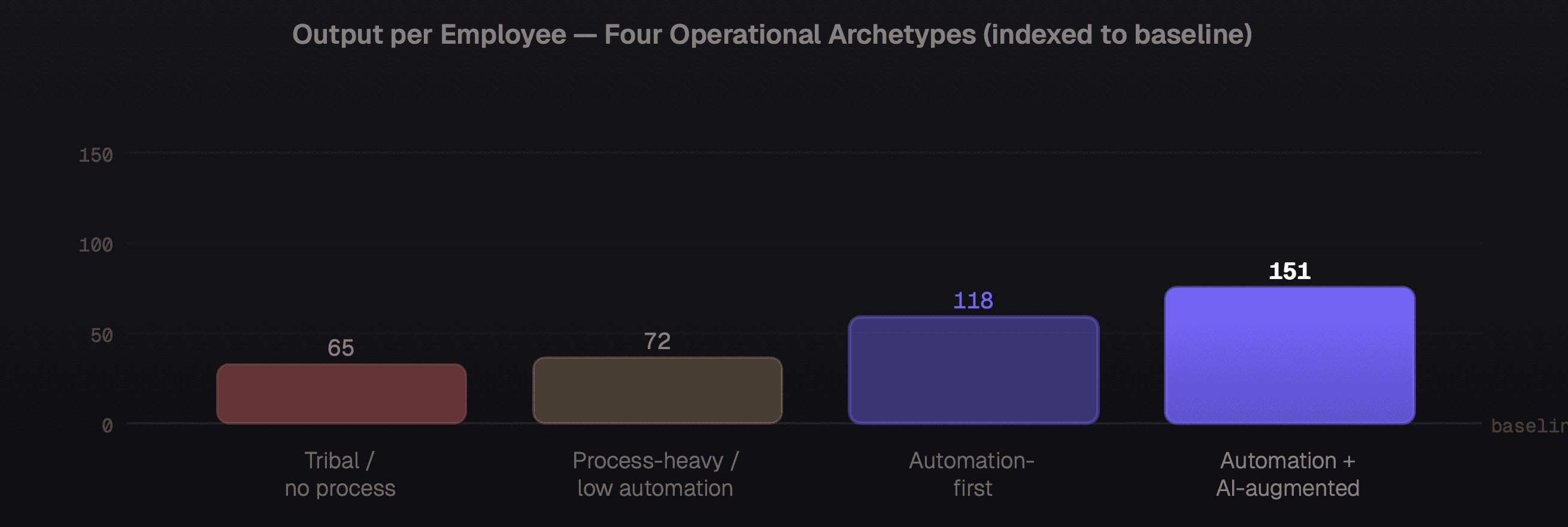
The companies that scale cleanly don't have less coordination they have more efficient coordination. Every meeting replaced by an automated digest, every approval chain replaced by a delegated authority, every status update replaced by a live dashboard is a unit of organisational leverage. Accumulate enough of them and you can grow 6× without adding proportional overhead.
Operational design is a competitive advantage not because it makes you more efficient, but because it preserves the decision-making speed and individual contribution quality that made you competitive at 20 people.
The companies that lose that as they grow are the ones that treat operations as overhead rather than infrastructure. For the AI layer that accelerates all of this, see our guide to AI agents in business operations.
For the specific automation workflows that support scaling, see our tiered automation guide.