AI Agents in Business Operations: The Definitive 2026 Guide

Aidan Koh
CEO & Co-founder
7 min read
From reactive to autonomous, how AI agents are replacing the coordination layer in modern businesses, and the implementation patterns.
In 2022, a "modern ops stack" meant Notion for documentation, Jira for projects, Slack for communication, and a cluster of Zapier automations stitching them together. The smartest operations managers in the world were still spending 60% of their time routing information, chasing status updates, and formatting reports that would be stale by Tuesday.
That era didn't end gradually. It ended fast. And the companies that noticed early are now operating with a structural advantage that compounds every quarter.
This guide covers what AI agents actually do in an operations context, how they're architected, and the implementation playbook that's working for high-growth teams right now.
What makes an AI agent different from automation
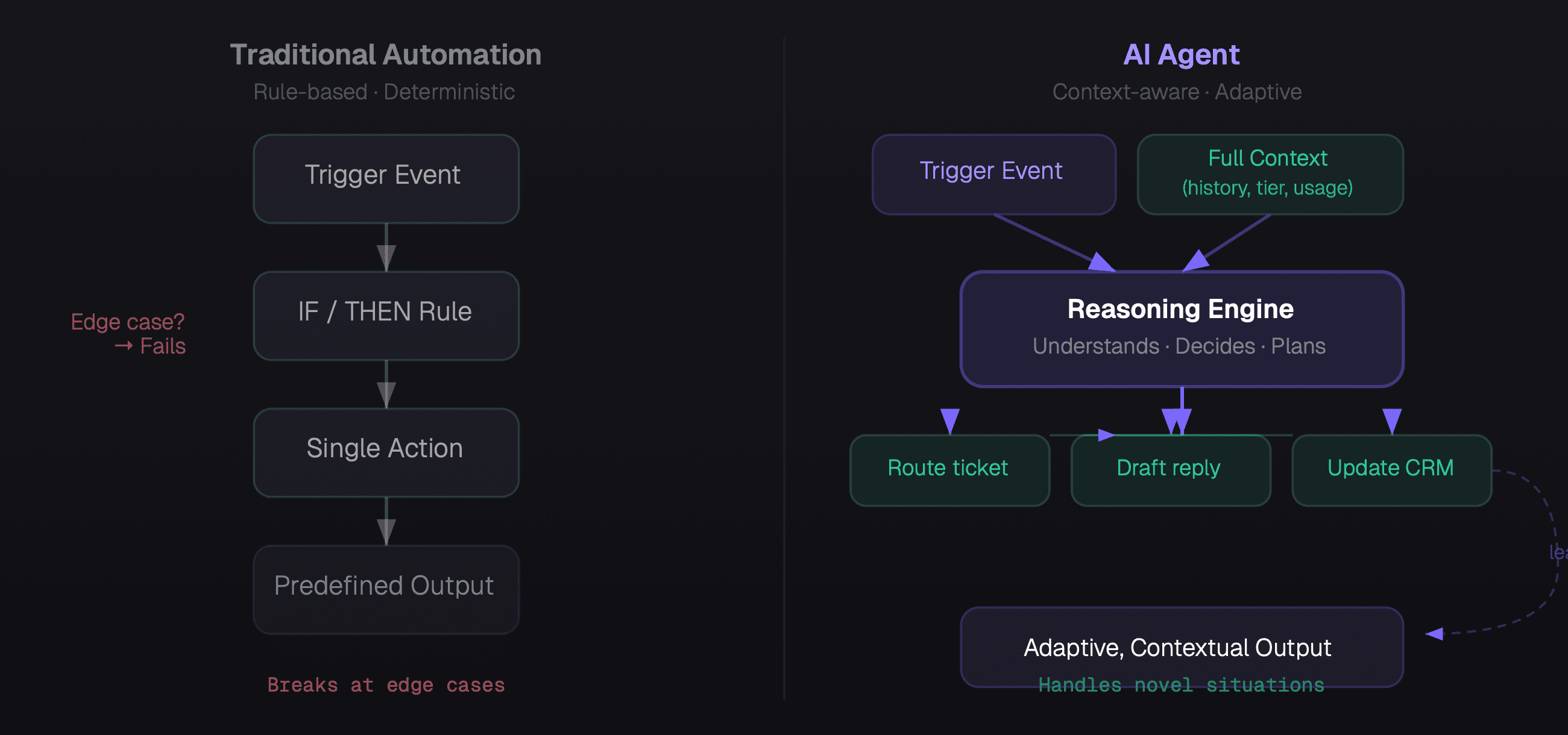
Traditional automation is deterministic: if X happens, do Y. It's powerful for high-volume, predictable workflows — sending a welcome email when someone signs up, or updating a CRM field when a deal closes. But the moment a situation requires judgment — routing a complaint to the right team based on tone and urgency, deciding whether a bug is P1 or P2, writing a context-rich escalation — traditional automation breaks down.
AI agents are different in three fundamental ways:
They reason about context. An agent doesn't just read the trigger event; it reads the thread history, the customer's billing tier, recent product usage, and open issues before deciding what to do.
They take multi-step actions. A single agent can read a ticket, classify it, draft a response, route it, update three different systems, and notify a stakeholder — all in one continuous flow.
They improve over time. Agents that see thousands of similar decisions get better. They learn which escalations resolve fast and which drag on; which customers respond to one tone versus another.
Traditional Automation Rule-based · Deterministic Trigger EventIF / THEN RuleSingle ActionPredefined OutputEdge case?→ FailsAI AgentContext-aware · AdaptiveTrigger EventFull Context(history, tier, usage)Reasoning EngineUnderstands · Decides · PlansRoute ticketDraft replyUpdate CRMlearnsAdaptive, Contextual OutputBreaks at edge casesHandles novel situations
Fig 1. Traditional automation vs AI agent architecture — the core structural difference
The three tiers of operational AI
Not all AI in operations is created equal. After working with thousands of teams deploying operational AI, we see three distinct tiers — and where you start matters enormously for your long-term architecture.
Tier 1: Intelligent Triage
The easiest win. Every organization has inbound request streams — support tickets, HR queries, sales inquiries, IT helpdesk — where a significant portion of effort is just figuring out who should handle what. Tier 1 agents read incoming requests, classify them by type and urgency, enrich them with context from existing systems, and route them to the right queue or person.
A well-implemented triage agent typically reduces routing time from hours to seconds and cuts misroutes by 80–90%. The ROI is immediate and measurable.
Tier 2: Autonomous Response
Once you've built routing, the next layer is response. Tier 2 agents don't just route — they act. For routine request types (billing refunds under threshold, password resets, FAQ responses, status updates), agents can resolve end-to-end without human involvement. They draft, send, and log — all with appropriate personalization and context.
DATA POINT FROM NEXUS CUSTOMERS
Teams that reach Tier 2 automation typically resolve 58–72% of inbound requests without human touch, reducing average resolution time from 3.8 days to 14 hours.
Tier 3: Proactive Intelligence
The most advanced — and most valuable — tier. Tier 3 agents don't wait for requests. They monitor signals across your entire stack, identify patterns that humans would miss, and proactively surface insights, risks, and opportunities. This is where AI shifts from reactive to truly operational.
Examples: an agent that notices a key account's product usage dropping 40% before they file a cancellation request; an agent that detects an unusual spike in payment failures and opens a bug before your support queue explodes; an agent that identifies which pipeline deals are stalling and drafts personalized outreach for the AE.
How to architect your first agent deployment
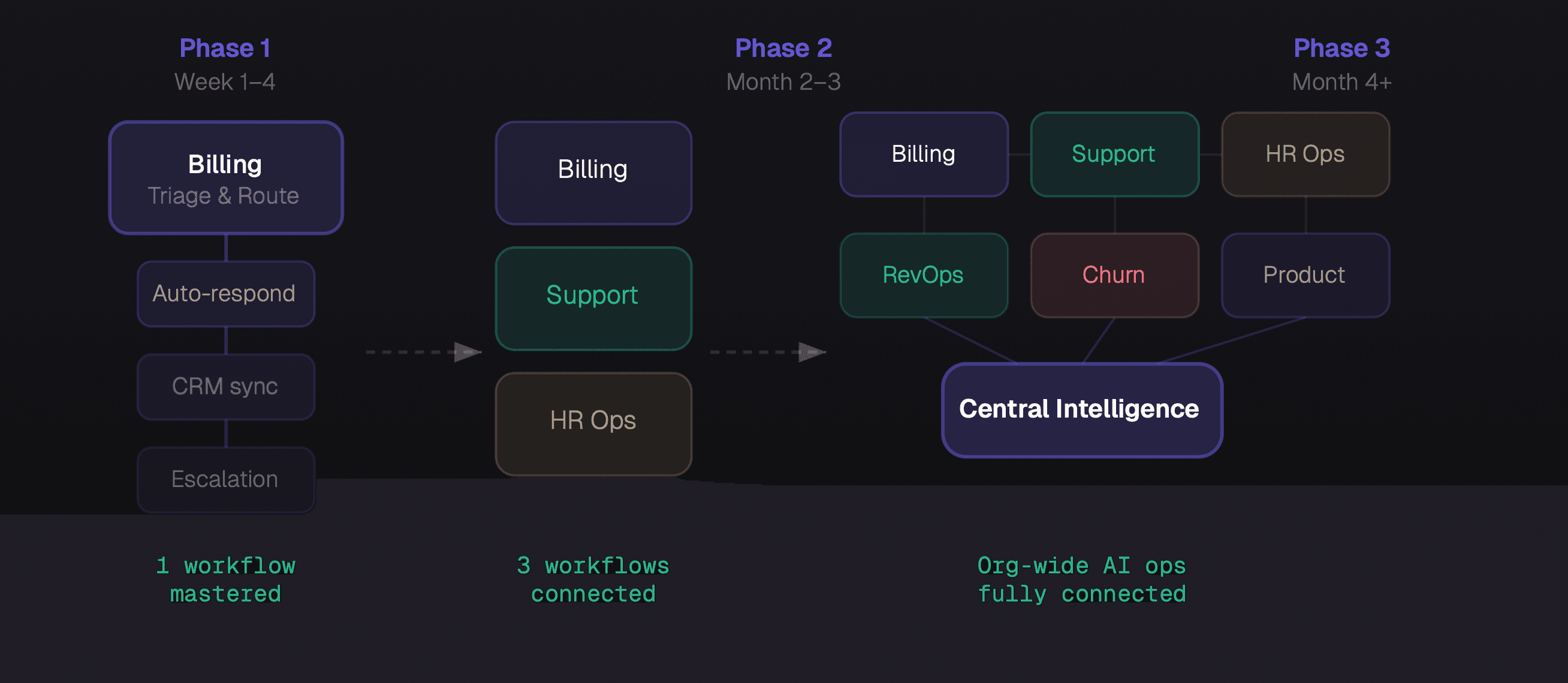
The biggest mistake teams make is starting too broadly. They want the agent to handle everything — every ticket type, every edge case, every decision — on day one. This produces a system that handles nothing well.
The right approach is the narrow-deep strategy: pick one workflow, one team, one request type, and build an agent that handles it flawlessly. Then expand horizontally.
Phase 1Week 1–4Phase 2Month 2–3Phase 3Month 4+BillingTriage & RouteAuto-respondCRM syncEscalation1 workflowmasteredBillingSupportHR Ops3 workflowsconnectedBillingSupportHR OpsRevOpsChurnProductCentral IntelligenceOrg-wide AI opsfully connected
Fig 2. Narrow-deep deployment strategy — master one workflow before expanding horizontally
The five workflows to automate first
Based on deployment data across thousands of companies, these five workflows deliver the fastest ROI with the lowest implementation risk:
Inbound ticket triage and routing. High volume, highly repetitive, clear classification rules. Build this first. See also our guide on what to automate first in your ops stack.
Customer health monitoring. Daily scans of usage data, support history, and payment patterns. Flag accounts showing early churn signals before they become cancellations. For deeper coverage, read our post on the six churn signals hiding in your data.
Status reporting and standups. Aggregate updates from Jira, GitHub, and Slack every morning; generate a human-readable summary for leadership. Eliminates 60–80% of status meeting time.
New customer onboarding sequences. Trigger personalized onboarding flows based on ICP segment, company size, and initial usage patterns — automatically and without a CSM touch for every account.
Approval and escalation routing. Build a rules engine that handles approval chains for common requests (expense approvals, access requests, content reviews) with context-aware escalation when thresholds are exceeded.
Measuring agent performance
Most teams measure AI adoption by counting automated workflows. This is the wrong metric — it measures activity, not impact.
The right metrics for operational AI are:
Time-to-resolution (TTR). How long from the resolution request? A good Tier 2 agent cuts this by 60–80%.
Escalation rate. What percentage of requests require human intervention? Track this by category. It should decrease over time as your agent learns.
Decision quality score. Spot-audit a random sample of agent decisions weekly. Compare them to what a skilled human would have done. Deviation rate should be below 5% for mature agents.
Human hours recaptured. The clearest business metric. Multiply TTR improvement by volume to calculate weekly hours saved. Multiply by the fully-loaded cost.
The goal isn't to automate tasks. It's to free your best people to do the work only humans can do — strategy, relationships, creativity, judgment. The math is simple: if an agent saves a senior ops manager 15 hours a week, you're getting a $150k+ annual return per person.
Common failure modes and how to avoid them
Four out of five AI ops initiatives that underperform do so for predictable reasons:
1. Starting too broad. Teams that try to automate everything simultaneously produce agents that are mediocre at everything. Use the narrow-deep strategy. Master one workflow, measure it, then expand.
2. Under-investing in context. Agents are only as smart as the context they have access to. If your agent can't read CRM notes, recent support threads, and billing history simultaneously, it'll make decisions that look dumb. Integration depth matters more than model capability.
3. No human-in-the-loop for edge cases. Even the best agents encounter situations they shouldn't handle alone. Build clear escalation paths with full context handoff. The worst outcome is an agent that handles an edge case poorly and silently — the customer never knows why they got a bad experience.
4. Forgetting to measure decision quality. Volume metrics create a false sense of success. An agent that routes 10,000 tickets but misclassifies 20% is a liability, not an asset. Measure accuracy weekly, especially in the first 90 days.
If you're thinking about scaling your team alongside your AI agents, our piece on scaling teams without scaling overhead is worth reading alongside this one — the two strategies reinforce each other.
AI agents in operations are not a future technology. They're a current advantage — and the gap between early adopters and late adopters is already measurable in headcount efficiency, resolution speed, and customer retention. The playbook is clear. The only question is where you start.