Async by Default: Running a Global Team Without Killing Productivity

Aidan Koh
CEO & Co-founder
12 min read

Nine tactical changes that eliminate time-zone friction, reduce meeting load by 60%, and let distributed teams ship faster than co-located ones.
The default setting for most companies is synchronous. Meetings to make decisions. Stand-ups to share status. Calls to align on priorities. This model worked fine when everyone was in the same building. It breaks at scale — and it breaks badly when your team spans six time zones.
The companies winning with distributed teams aren't just tolerating async, they're optimizing for it. They've rebuilt their operating model from the ground up around the assumption that real-time communication is the exception, not the default. The result: faster decisions, less coordination overhead, and teams that consistently outship their co-located counterparts.
This is the playbook. Nine changes, each one independently valuable, collectively transformative. For the tooling layer that makes this work at scale, see our guide on what to automate first in your ops stack.
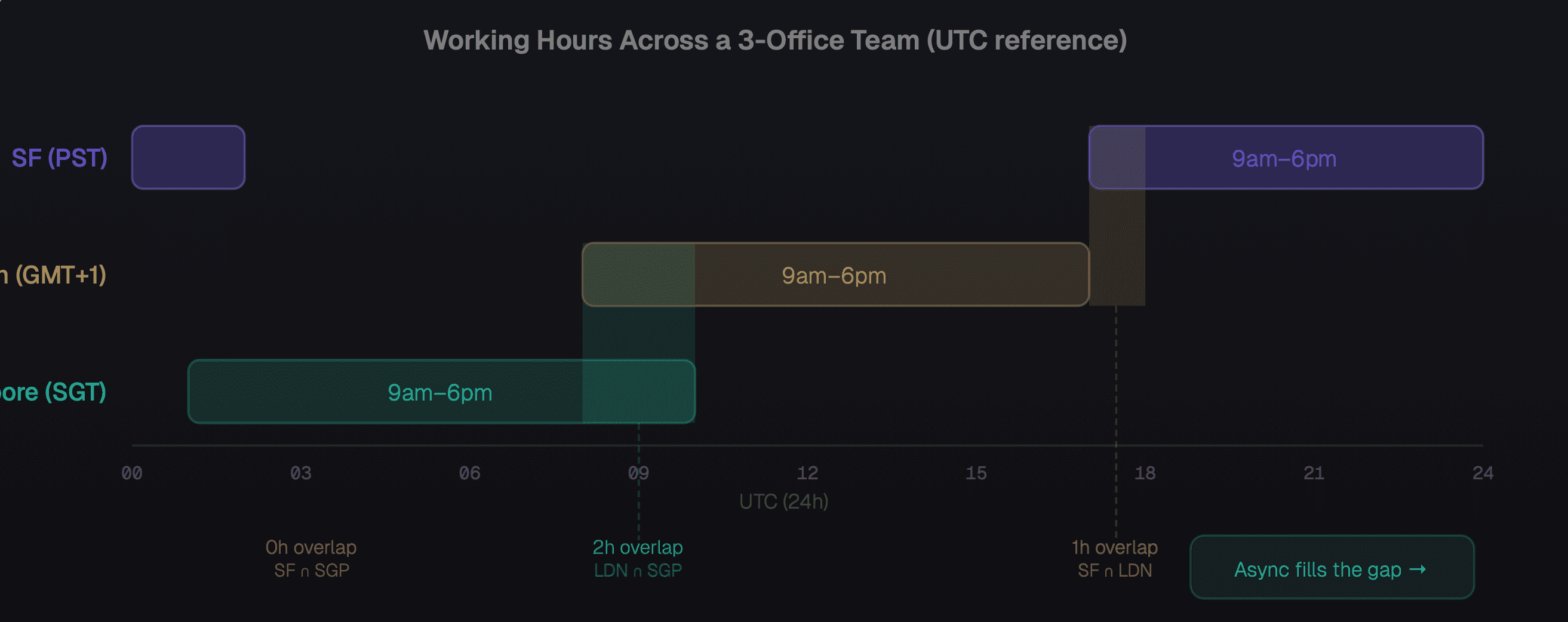
Real-time overlap between SF, London & Singapore — async communication bridges the remaining 21+ hours.
The async mindset shift
Before the tactics, the mindset: default to async, escalate to sync. This sounds simple but it's a complete inversion of how most teams operate. Synchronous communication should require justification "I need real-time collaboration because X" not async communication.
The rule of thumb that works: if the decision or output can wait 4 hours, it should be async. If it can't, it warrants a meeting but only with the minimum people necessary.
Nine tactics that actually work
Replace status meetings with automated digests
Your morning standup exists to answer: what happened, what's next, what's blocked. All three answers exist in your tools already Jira, GitHub, Slack. An automated digest assembled at 8am local time for each office eliminates the standup without losing the information. Teams that do this consistently reclaim 2–4 hours per person per week. Nexus's operations engine can build this digest automatically from every connected tool. See also: AI agents in business operations.
Create a written decision log with a 48-hour comment window
Every significant decision should be written up context, options considered, recommendation, rationale and posted with a 48-hour window for asynchronous input. After 48 hours, the decision is final unless someone explicitly escalates.
This eliminates the "I wasn't in the meeting" problem and creates institutional memory. Tools like Notion or Nexus's documentation module work well for this.
Define response-time SLAs by channel
Slack DMs ≠ urgent. Email ≠ 24-hour response. Explicitly define what each channel means in terms of expected response time: Slack DMs: 4 hours; project channels: next working day; email: 48 hours; @here/@channel: urgent, 1 hour.
Shared SLAs eliminate the anxiety of watching a message go unread and the passive pressure to be always-on.
Record, don't narrate — use async video for complex context
Some things are hard to explain in text but easy to show. A 3-minute Loom recording of a product decision, a design review, or a technical walk-through conveys nuance that a Slack thread never can.
The key: record with a clear title, a written summary in the first comment, and timestamps for key points. Recipients can watch at 1.5× speed and jump to what matters.
Institute "no-meeting Wednesdays" (and protect them aggressively)
One uninterrupted day per week for deep work creates disproportionate output. The research is clear: context switching between meetings reduces cognitive performance by 40%.
A protected day recaptures that. The hard part is protecting it once exceptions start, they multiply. Leadership has to model the behavior, not just mandate it.
Make every meeting opt-in, not default-included
Change your meeting culture: the organizer specifies who is required vs optional. Optional attendees get a written summary within 24 hours. Declines are not career limiting.
This single change typically reduces meeting attendance by 35–50% without reducing decision quality because most meetings include people who don't need to be there.
Build a "timezone-aware" project management workflow
Tasks that require cross-timezone handoff need explicit "ready for pickup" states. When an SF engineer finishes their part of a feature at 6pm, the Singapore team needs to know it's ready at 8am their time without a Slack message.
Good project management tooling (like Nexus's project intelligence module) surfaces these handoffs automatically and notifies the right person at the right time.
Invest in a living, searchable knowledge base
The #1 async killer is a question that blocks someone for hours because the answer lives in someone's head in a different time zone. A well-maintained internal knowledge base searchable, organized, and kept current eliminates this.
The discipline: every decision, process, and FAQ gets documented within 24 hours. The best teams treat documentation as a first-class deliverable, not an afterthought.
Rotate meeting times for cross-timezone syncs
When real-time collaboration is necessary across time zones, rotate the burden. Don't let SF always call at 8am their time (5pm London, midnight Singapore). Rotate weekly: one week Singapore-friendly, next week London-friendly, next week SF-friendly.
Record every cross-timezone meeting and post the recording within 2 hours. No one should have to attend at 1am to stay informed.
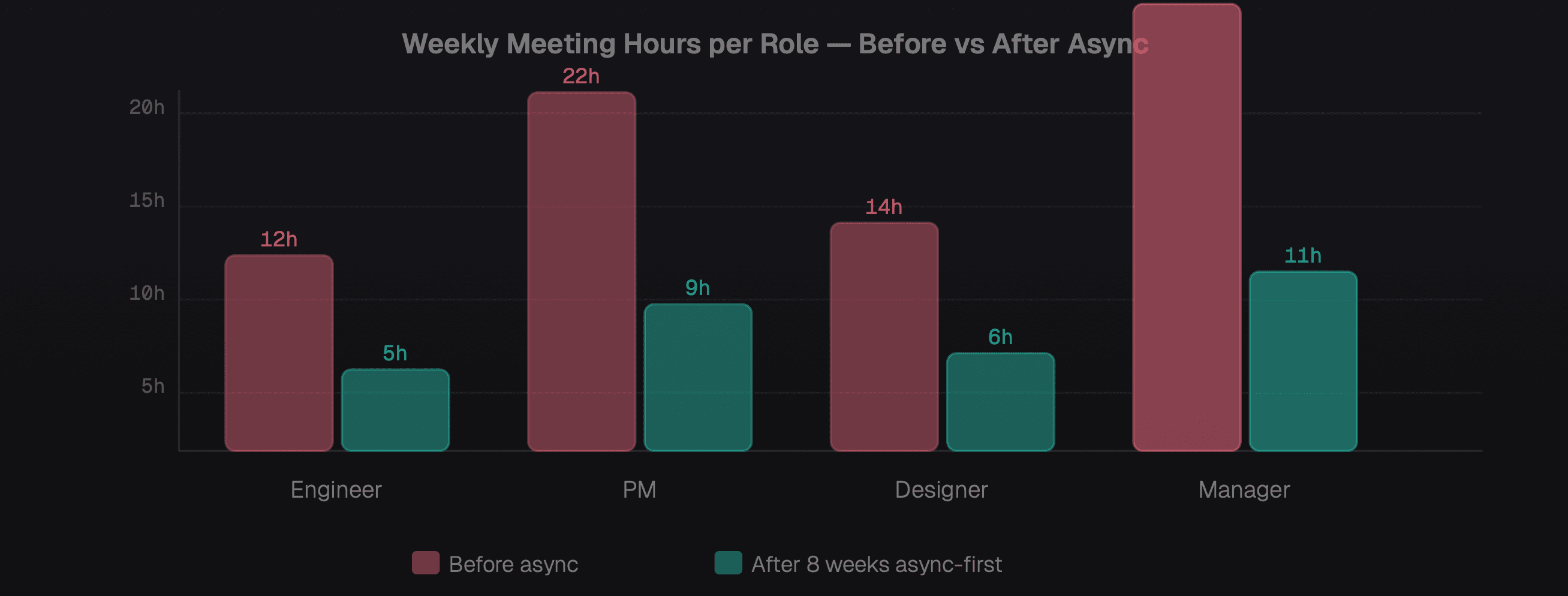
Weekly meeting hours before vs. after implementing an async-first operating model — all roles benefit, managers most
What you lose (and how to compensate)
Async-first has real trade-offs. Ignoring them leads to cultural problems that undermine the productivity gains.
Relationship warmth. Relationships built over Slack threads are thinner than relationships built over lunch. Counter this with intentional synchronous social time: quarterly in-person gatherings, weekly optional "social hours" across time zones, birthday and milestone recognition that doesn't require presence.
Junior team member development. Junior employees learn by osmosis — overhearing senior people reason through problems, getting informal feedback in the moment. In async cultures, this disappears. Counter with structured mentorship, recorded decision walk-throughs, and explicit "why did I do this" annotations on your work.
Speed on ambiguous problems. Some problems genuinely require real-time back-and-forth to resolve quickly. Know which ones they are. Make a clear list: "these problem types warrant an immediate sync." Don't let that list expand — but don't pretend the exceptions don't exist.
Async isn't a cost-cutting measure. It's an architectural choice that forces your organization to communicate more precisely, document more thoroughly, and trust more deeply. The teams that do it well are measurably better not just more efficient.
The tooling and automation decisions that underpin async operations are covered in detail in our post on scaling teams without scaling overhead. For the AI layer that makes automated digests and cross-timezone handoffs possible, see our post on AI agents in business operations.
The nine tactics above aren't a complete methodology they're a starting point. The discipline required is cultural, not technological: leadership must model async behavior before it becomes the default. Once it does, the compounding advantage is real and durable.